Annual Report · 2026 / 1447–48
Maktab & Darul Uloom Report
A community that keeps growing.
To the patrons of Masjid Ibrahim & its institutions, to the families who attend, and to those who quietly do this work year after year — this report is for you as much as ours.
01 · Masjid Ibrahim
A masjid that keeps making room.
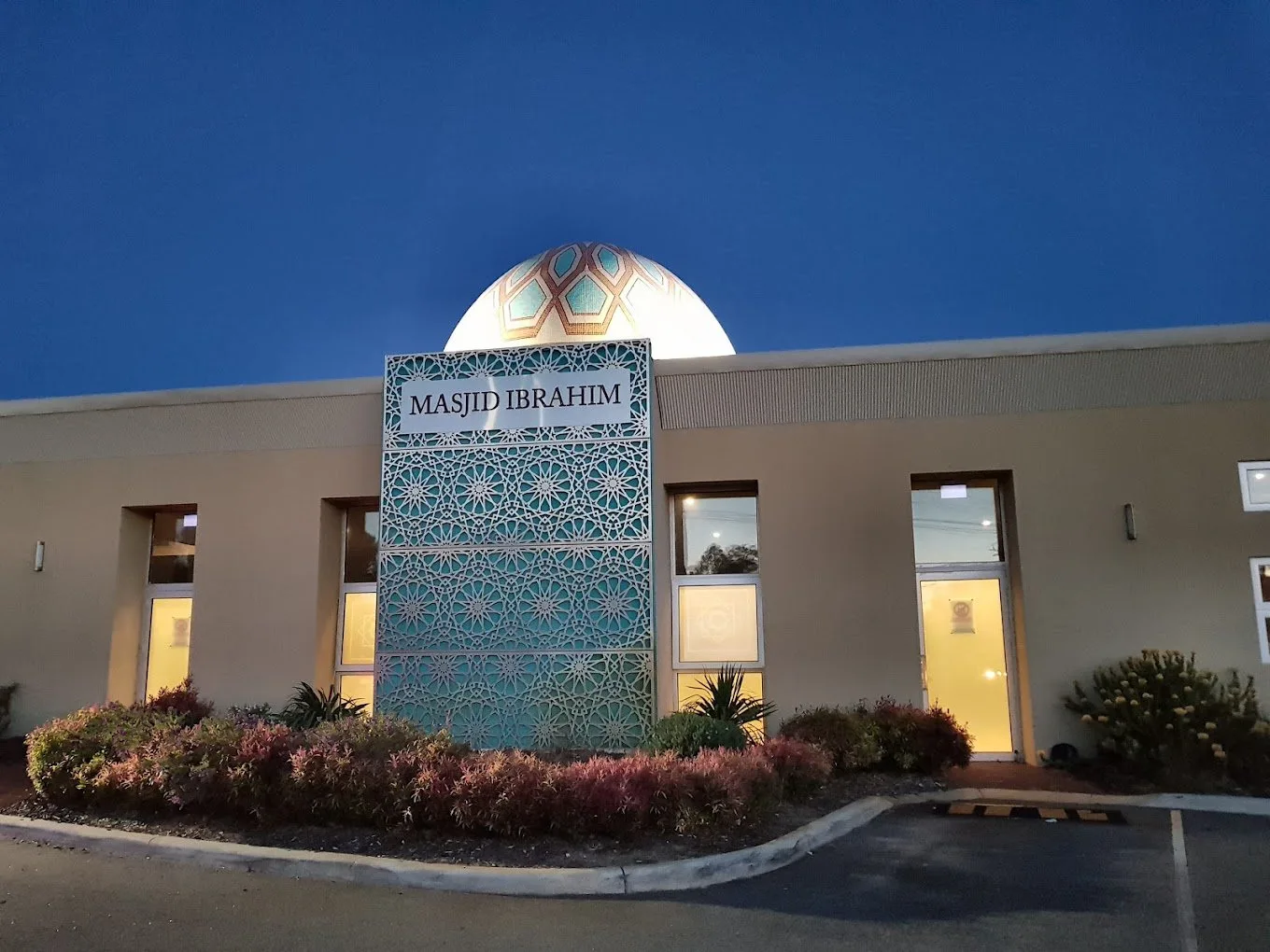
Masjid Ibrahim was raised with a simple intention: to serve the local and global Muslim community in every capacity it could — the five daily salah, the education of its children, the burial of its dead, the gathering of its people in the month that matters most, and simply to hold the community and its īmān together.
The clearest measure of the masjid is not in this report. It is in the shoes at the door on a Friday. Congregations have grown steadily year on year: the places fill for Jumu‘ah, and the busiest nights of Ramadān and the two Eids stretch every space the building has. What was once comfortable is now full.
That growth is being answered in brick and asphalt. Stage one of the car park extension is complete, with stage two to follow once the masjid is connected to the sewerage. A new building block is planned to house classrooms, administration, a library, a janāzah bathing and shrouding facility, and a multi-purpose student and community space.
Since its humble inception the masjid has hosted many local and foreign ‘ulamā’ and visitors, run programmes for every sector of the community, and provided services without compromise and within the teachings of the dīn.
The imams
Four resident imams lead the prayer, teach, and answer the questions the community brings to the masjid door — from a marriage contract to a difficult burial, from a fiqh question to a family in need.
The masjid year — worship, service, and the community in between
Ramadān
The busiest month of the year. Post-fajr halaqāt, pre-iftār sessions, programmes for the sisters and post-tarāwīh tafsīr, with guest ‘ulamā’ and reciters joining across the month. A sunnah-inspired daily iftār runs through the “sponsor an iftār” programme, and the last ten nights are given to i‘tikāf on a full daily schedule.
Visiting scholars
Local and international scholars and qurrā’ have visited the masjid over the years, teaching, reciting and sitting with the community. These visits are among the most anticipated parts of the Ramadān calendar.
Nikāḥ & marriages
Islamic marriages are conducted regularly at the masjid. One of the imams is a registered marriage celebrant, so the religious and civil steps can both be completed in one place.
Janāzah
Janāzah prayers are conducted at the masjid on request, and the imams assist families through the burial process. A dedicated bathing and shrouding facility forms part of the planned new building.
Open days & welfare
Regular open days invite the wider community in to meet the imams and staff. Throughout the year the masjid supports local organisations and social welfare collections, and contributes to community fundraisers when the need arises.
Qurbānī & Hajj
Qurbānī and udhiyyah are supervised by ‘ulamā’ across several countries, and annual Hajj workshops are held for intending hujjāj with guest scholars presenting.
02 · Darul Uloom Masjid Ibrahim
Seventy-three students, one tradition of learning.
Two programmes under one roof: Hifz al-Qur’ān, where the Book is committed to memory, and Aalimiyyah, where it is understood. Darul Uloom began sixteen years ago with a handful of students and a single intention — that the traditional sciences would not simply be remembered in this community, but taught in it. The growth has been almost entirely in Hifz, which now carries 64 students against 48 two years ago.
Part oneHifz al-Qur’ān
Sixty-four students are enrolled in Hifz this year. Twenty-four attend full time, two sessions each day from 6:00am to 12:10pm; forty attend part time, before school from 6:00am to 8:00am, fitting memorisation around their ordinary schooling. Five teachers carry the programme between them.
Home-schooling registration remains mandatory for full-time students, and the programme pairs memorisation with Islamic studies and tarbiyyah — because the point of memorising the Qur’ān is not only to hold it, but to be held by it.
Three students completed the memorisation of the Qur’ān this year and were honoured at the graduation ceremony on Saturday, 28 November 2026.
Part twoAalimiyyah
Nine students are enrolled in the Aalimiyyah programme this year — the most demanding course of study at Darul Uloom and its smallest, by design. Classes run daily from 7:30am to 12:10pm, and the curriculum runs the full seven years: four years of foundation study followed by three years of specialisation in Arabic language and grammar, ‘aqīdah, tafsīr, qirā’ah, hadīth and fiqh, studied in depth rather than surveyed.
The measure of a programme like this is not its enrolment. Including 2026, eleven students have graduated as ‘ulamā’ and one as a Mufti. One serves as imam at Masjid Ibrahim; one as imam at Sakinah Islamic Centre; two have established their own institute; one teaches in a higher Islamic studies programme; one teaches a fiqh specialisation course; and one continues further studies — along with serving, teaching and leading the community in various capacities. An Aalimiyyah programme is not for volume, but for weight.
3 years specialisation
The complete traditional curriculum, taught in the masjid.
Recognition
Formal credit for a traditional education
This year Darul Uloom students may become eligible to sit exemption examinations with Charles Sturt University through its Islamic Studies programme (CSU : ISRA). The university has assessed the Darul Uloom curriculum unit by unit and accepted that what is taught here meets the standard of what it teaches there.
The years spent in the masjid can now count towards a university qualification — opening doors to chaplaincy, teaching, community leadership and further study, without asking the student to leave the tradition that formed them.
“The traditional programme, taught in the traditional way, now carries formal academic recognition.”
03 · Maktab Ibrahim
The Gateway
The after-school school: twenty-five classes from Beginner to Senior Girls, five afternoons a week, and a Saturday morning for the older students.
Student numbers
The roll at the close of each reported year; 398 is confirmed 2027 enrolment, not a projection.
The teaching team is twenty-one teachers, five male and sixteen female, supported by five relief teachers. At 338 students that is roughly sixteen students per teacher, absorbed by the afternoon class structure, where most levels run two parallel classes of around twenty.
The Maktab runs a structured syllabus spanning Qur’ānic recital and Islamic studies, formal assessment twice yearly at the close of Terms 2 and 4, written reports at year’s end, and a parent–teacher meeting immediately following the mid-year assessments.
Senior and Saturday classes
Class 10 students, male and female aged 16 to 18, continue alongside a Saturday morning cohort for university-aged sisters, 9:00am to 10:30am. Students are separated by gender from Class 3 onwards, with male teachers for the boys and female teachers for the girls.
The year — four terms, one continuous programme
- Ramadān classesSat & Sun · 21, 22, 28 Feb · 1, 7, 8 Mar
- Eid partyThursday 2 April
- Teacher meetingFriday 15 May
- Eid al-AdhaFriday 22 May
- Mid-year assessmentsMon 22 – Fri 26 June
- Boys’ soccer outingMonday 6 July
- Sisters’ outingSaturday 18 July
- Parent–teacher meetingFriday 24 July
- Maktab Fun DayFriday 25 September
- Sports Carnival2 November · Sutherland Park
- Final examinationsMon 16 – Thu 23 November
- Class partyFriday 27 November
- AssembliesMales 2 Dec · Females 3 Dec
خَيْرُكُمْ مَنْ تَعَلَّمَ الْقُرْآنَ وَعَلَّمَهُ
“The best of you is the one who learns the Qur’ān, and then teaches it.”
04 · Enquiries
Speak to the right person.
Whether you are enrolling a child, considering the Hifz programme, or thinking about the Aalimiyyah course — go directly to the scholar who carries it.
For general masjid matters — janāzah, nikāḥ, visits, donations — please contact the masjid office or any of the imams above.
05 · Contributions
This work is carried by hands like yours.
No student at Masjid Ibrahim pays the full cost of their own education. The difference is made up by the community — quietly, consistently, year after year.
Every hāfiz who completes the Qur’ān, every child who learns to read it, every Aalim who goes on to serve a community — each is the product of someone else’s generosity. A sponsored iftār in Ramadān. A contribution towards a teacher’s salary. A donation that quietly covers a family who could not otherwise afford the fees.
“Whoever builds a masjid for Allah, Allah will build for him a house in Paradise.”
Donation details
- Account name
- Southern River Mosque
- BSB
- 066 165
- Account no
- 10408757
- Reference
- MASJID / MAKTAB / HIFZ / AALIM
Use the reference that matches your intention. Donations can also be handed to the masjid office or any of the imams after salah — receipts available on request.
Donate online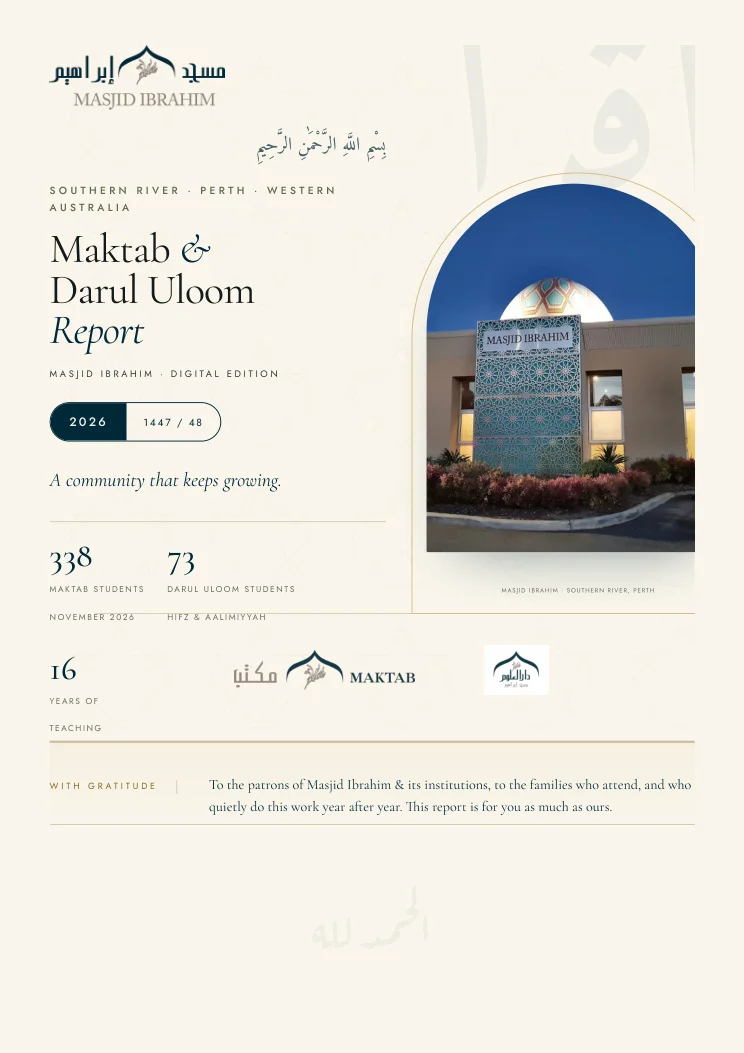
Download the full report
Maktab & Darul Uloom Report 2026 / 1447–48, digital edition — 12 pages, PDF (2.4 MB). Maktab, Darul Uloom, Hifz, Aalimiyyah and 2027 intake figures are the 2026 returns.
“And say: My Lord, increase me in knowledge.” — Qur’ān, Tā Hā 20:114